LLM-supported software development: Methodological insights from practice#
A series of experiments to explore new development approaches#
Since the availability of powerful large language models, the question arises: How is the software development process changing? What are the practical possibilities – and where are the limits? This series documents methodological observations from various experiments and development projects that were realised with LLM support.
As a comic#
Overview of AI tools#
Overview of AI Tools#
| Tool | Function | Key Challenges |
|---|---|---|
| Chart-Tool | Creates interactive diagrams from CSV/Excel through natural language input | Automatic error correction in generated code; intelligent intent recognition from user queries |
| Chat | Web-based interface for dialogues with locally operated LLMs | Session management; automatic summarization |
| Diagram-Tool | Generates technical diagrams (flowcharts, mindmaps, etc.) from natural language | Multi-stage validation pipeline; Mermaid syntax corrections |
| Doc | Automatic summarization of PDF/DOCX/ODT documents | Synthesis of partial summaries for extensive documents; token limits |
| Flex AI Mapping | Generic information extraction system for websites; generates structured profiles through prompt-based configuration | Two-phase extraction with QA layer (Extract + Validate); entity normalization; management of many parallel LLM calls; prompt dependencies |
| KI-Umfrage | Intelligent survey system with automatic follow-up questions for vague answers | Clarity score evaluation (0-1); adaptive follow-up generation; balance between follow-ups and user acceptance |
| ppt-helper | Develops presentation structures from uploaded documents | Multiple agents; iterative refinement without content generation |
| stt-helper | Transforms machine transcripts into professional documents | Multi-stage LLM workflows (3 phases); context-based technical term recognition |
| Staffcost-Tool | Calculates personnel costs for third-party funded projects through natural language input; combines LLM parameter extraction with deterministic TV-L calculation | Extraction of pay grades, levels, and periods from free text; interactive queries for incomplete information; annual slice calculation with level progressions |
| Style-Tool | Transforms texts according to predefined style profiles | Extraction and application of linguistic features; fine-tuning through change pattern analysis |
| Stylish | Slider-based text style editor with two-stage process (neutralization → stylization); 34 sliders for direct style parameter control | Intensity levels for distinct style implementation; prompt engineering for the executing LLM; balance between control (34 sliders) and usability |
| TextTool | Iterative text editing with predefined functions (correction, rephrasing, etc.) | History management (10 steps); balance between standard functions and individual customization |
| Translate | Translates documents while preserving structure and formatting | Intelligent chunking with context preservation; parallel processing; glossary management |
| TalkToDocuments | Dialogue-based document analysis with precise source references | Management of many documents; automatic content preparation; source references |
| web-helper | Migrates web content from Plone to TYPO3 via JSON processing | JSON structure recognition (various content types); LLM-supported content analysis; Base64 image handling |
The experimental approach#
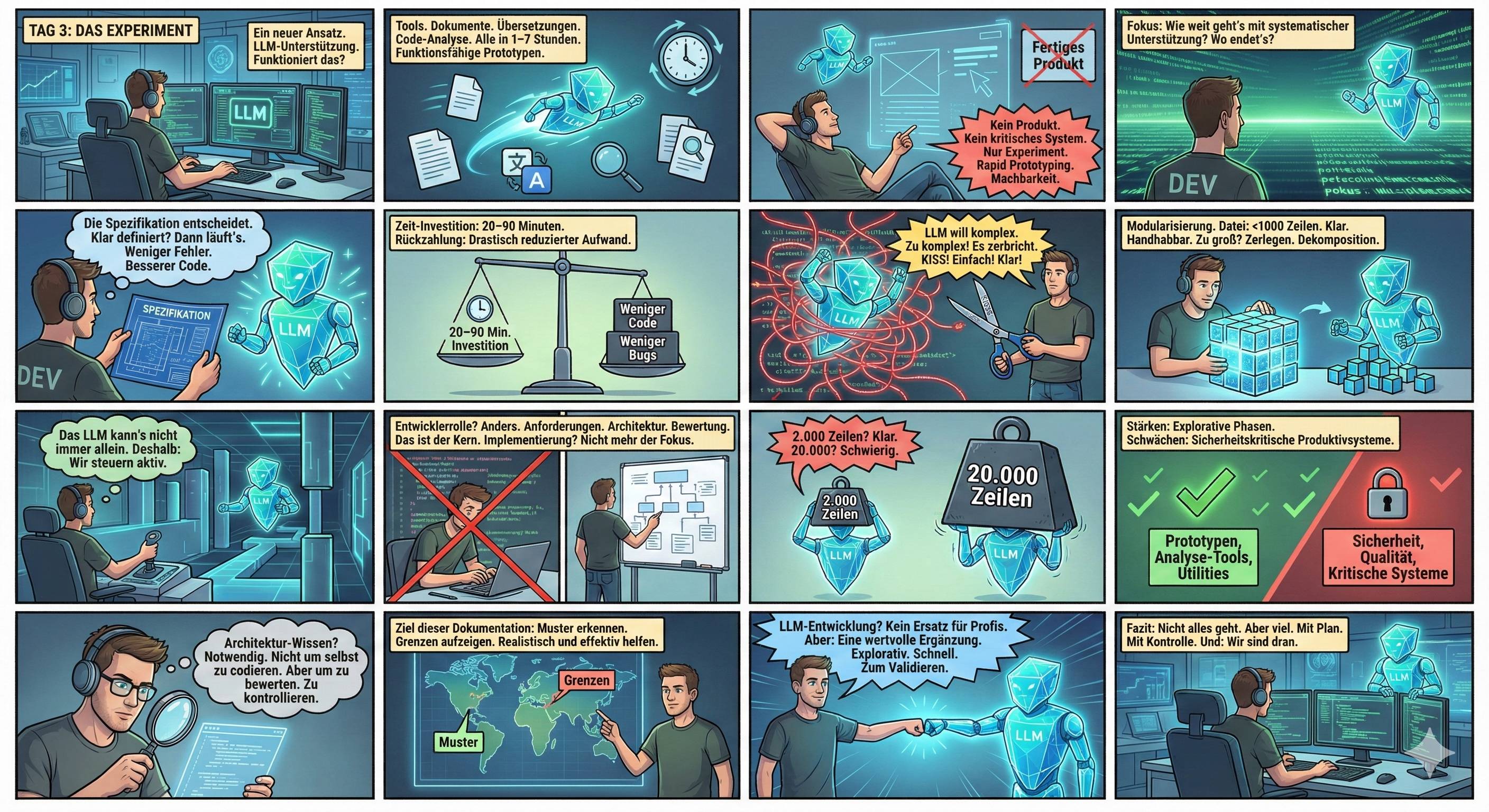
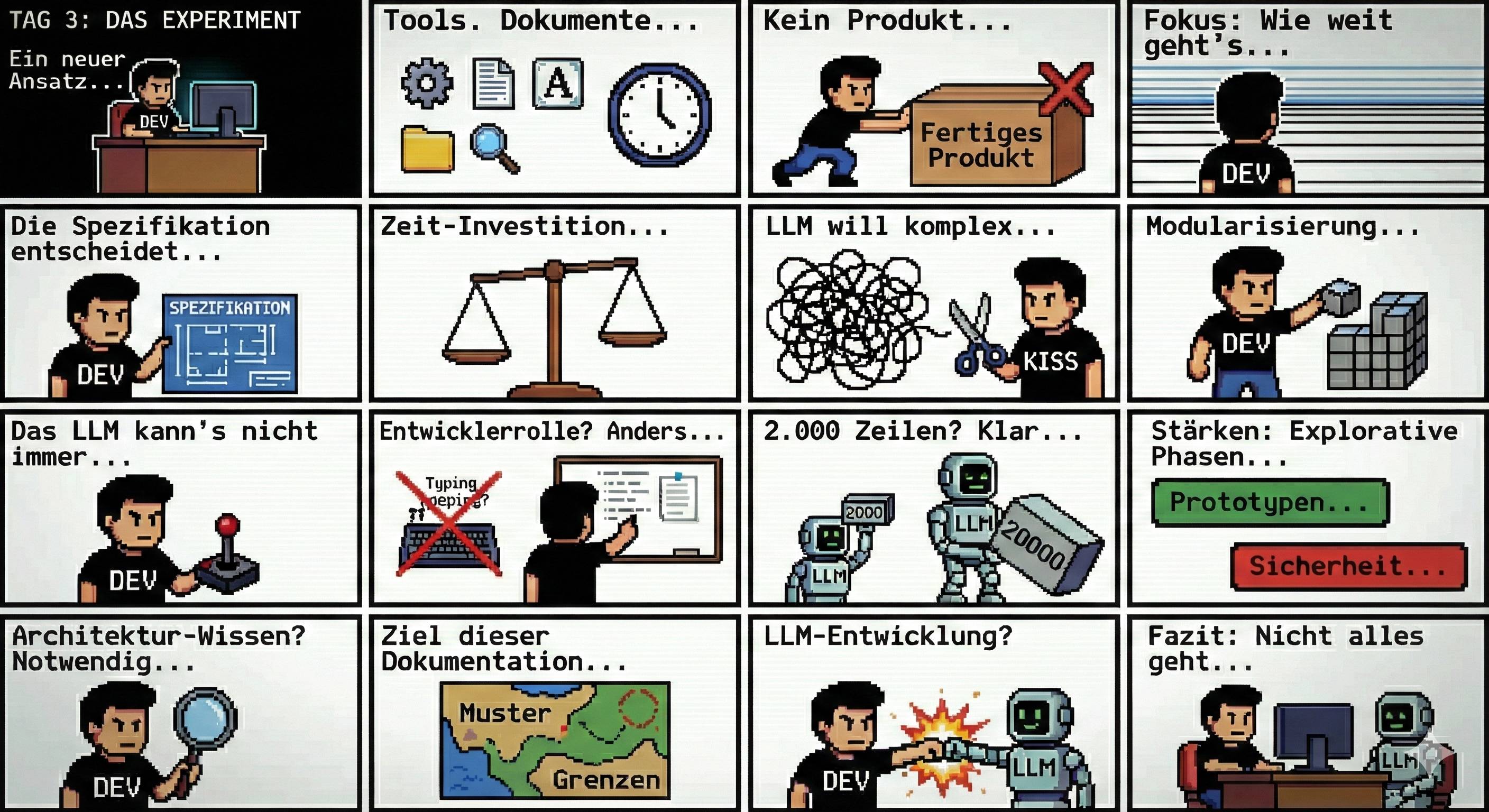
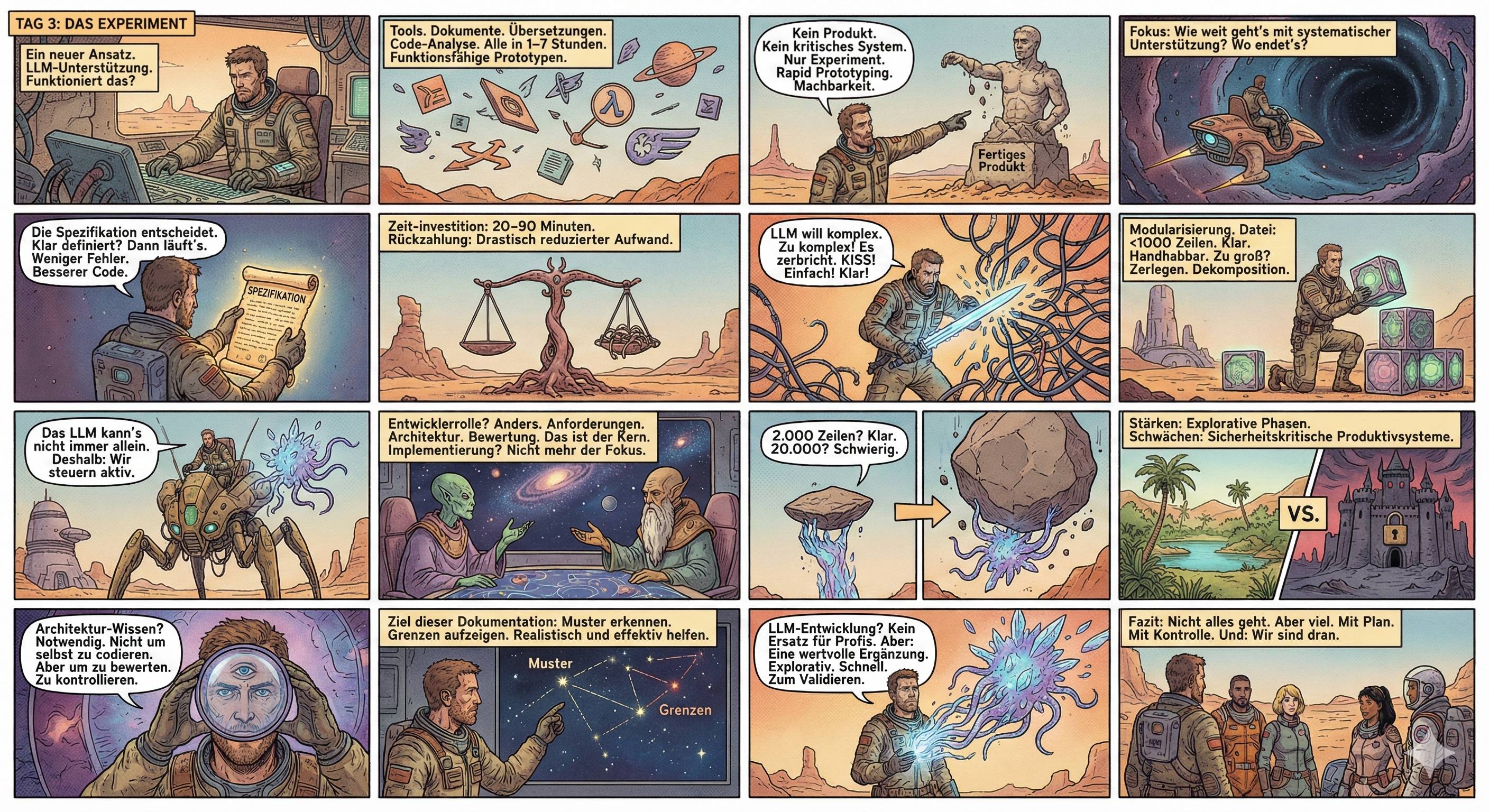
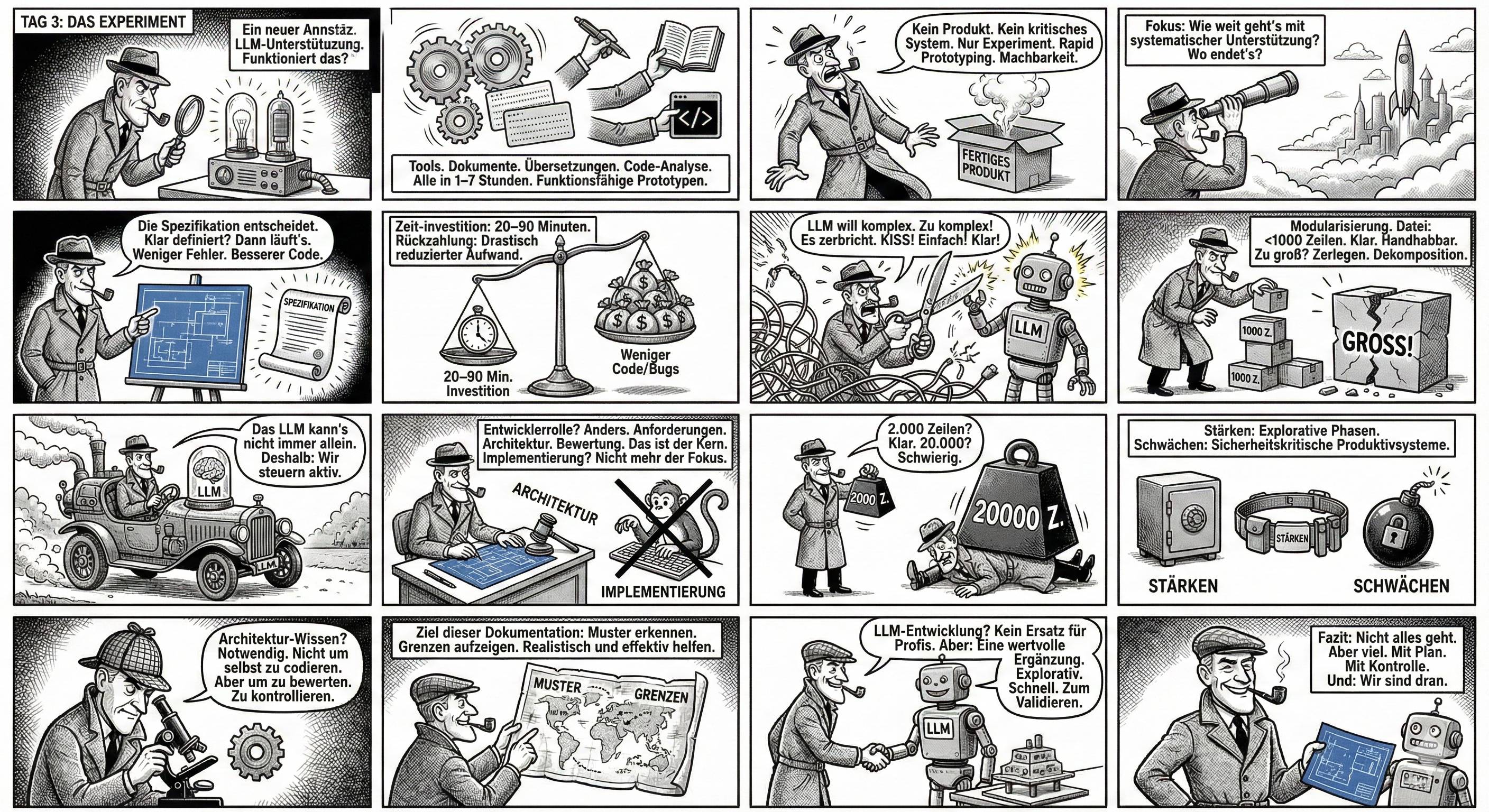
The documented projects include tools of varying complexity: from document processing systems and translation pipelines to code analysis tools. Development times ranged from one to seven hours for functional prototypes – a timeframe that contrasts sharply with conventional development approaches.
The focus is explicitly not on productive software for critical systems, but on exploratory development: rapid prototyping, feasibility studies, internal tools and specialised analysis tools. The focus is on the question of how far one can get with systematic LLM support – and where methodological limits become apparent.
Key findings#
Specification as a success factor: Across all projects, the quality of the specification proved to be crucial. The clearer the functional requirements, technical dependencies and architectural decisions were defined in advance, the more error-free the implementation was. The investment in specification quality – typically 20 to 90 minutes – paid off in drastically reduced implementation effort and increased code quality.
Active control required: LLMs tend to favour complex solutions that are likely to be contained in their training data but cannot always be replicated cleanly. Consistently demanding simple approaches (KISS principle) proved to be a necessary control task during specification creation.
Structuring for maintainability: Clear modularisation with size limits per file (typically less than 1000 lines) improved both code quality and maintainability by LLMs. Greater complexity had to be broken down into manageable parts – a decomposition that LLMs are not always able to perform effectively.
Changed developer role: The workflow is shifting: requirement clarification, architectural decisions and critical evaluation of LLM proposals are becoming core competencies, while implementation details are less important for these types of tasks.
Limitations and fields of application#
The projects reached various levels of complexity: from 2,000 lines of code for focused tools to almost 20,000 lines for more complex systems. It became clear that the methodology shows its strengths in the area of prototypes, analysis tools and internal utilities – but not for safety-critical production systems or components with high quality requirements.
A sound understanding of software architecture remains a prerequisite: not for coding yourself, but for specifying realistic and controllable solutions and evaluating the appropriateness of LLM proposals.
Purpose of this documentation#
This series focuses on potentially transferable patterns and methodological limitations, not on the tools developed themselves. The findings are intended to help other developers and teams realistically assess and effectively use LLM-supported development approaches.
The documented projects show that LLM-supported development is not a substitute for professional software development, but a valuable addition to exploratory phases, rapid prototyping, and the quick validation of tool ideas.
The following articles document specific projects and their specific methodological findings in detail.